Data Delivery
Guarantees
See The Dodgy State of Delivery Guarantees - YouTube
at-most-once
Send request, don’t retry, update may not happen
at-least-once
Retry request until
acknowledged, may repeat update
exactly-once
exactly-once=at-least-once+ Idempotence- exactly-once = (retry + idempotence) or deduplication
- It’s similar to TCP/IP. You implement a control protocol on top of an unreliable underlying protocol.
- “You are talking about distributed systems, nobody expects to read “exactly once” delivery.”
- “In my experience, the purist version of “exactly-once” exists as a vague, wishy-washy mental model in the brains of developers who have never thought hard about this stuff”
- “Within the context of a distributed system, you cannot have exactly-once message delivery.”
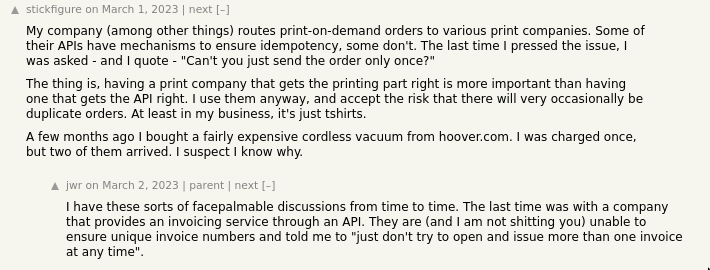
- How it’s achieved is via sort of faking it
idempotency: Either the messages themselves should be idempotent, meaning they can be applied more than once without adverse effectsde-duplication: Or we remove the need for idempotency through deduplication of messages in the queue.transactional processing: If processing of the message and then updating its status back to the queue is done in the same transaction(can be rolled back) that too can be a way I think. The transaction can be distributed or not.
- Even if something offers this gurantee, it’s better to write code in an idempotent manner
De-Duplication
- SQS FIFO queues have a 5-minute deduplication period. AWS is hashing the message body, saving the hash (for 5 minutes) and then each inbound message is hashed and a lookup is done on existing hashes to see if this one is a ‘duplicate’. This is how AWS SQS is probably able to offer
exactly-oncegurantee.- For such de-duplication service to be actually viable we have to have some kind of availability guarantee. With some kind of quorum this is possible. (See Consensus Protocols )
Challenges
Ordering
Idempotency
Data Delivery for Message/Task queues
Some comments from one of my queue implementations in pg that i did for a client
This was inspired by ideas of river queue but we did not have the requirement of transactional enqueueing
as this was part of a data pipeline and not userfacing stuff.
Queuing behavior
- queueing is not idempotent, you’re allowed to queue the same item again and again and it’ll keep creating duplicates which will mutate the state of the queue.
- We could however have de-duplication by adding some identity hash etc but guess not worth the effort atm
- function which will push items into is responsible for checking if the items need to be queued or not. Once item is in the queue it’ll be processed.
Processing guarantees
- processing of items from the queue is guranteed at-least-once execution,
- there is possibility of re-runs. processing of message should be idempotent.
- When updating the state/staus of the message, it can be done in either:
- A: different db transactions(sometimes this is unavoidable)
- B: same db transactions(ensures that re-runs always start in fresh state)
- eitherway, this should not be a problem if the entire nature of processing of a message is idempotent